Blog
Working from home and the engagement paradox
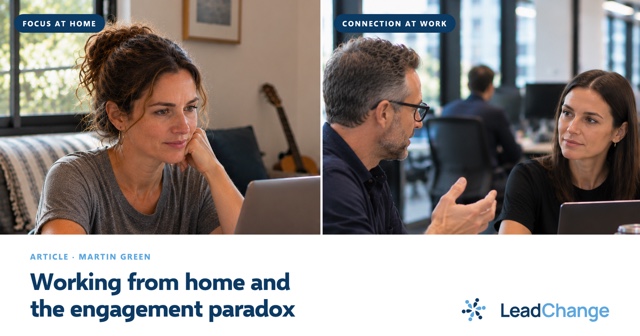
Flexibility lifts engagement in the short term. Relationships sustain it over the long term. Most return-to-office debates treat those as the same thing, and they are not.
Few workplace topics divide a leadership team faster than this one. Say "office" in the wrong tone and people hear a loss of trust. Say "flexibility" and others hear a loss of control. It is a provocative subject, and many leaders would rather leave it alone.
It cannot be left alone. Every organisation now runs some version of hybrid work, by design or by default. The question is no longer whether people should be in the office. It is what the office is for, and what we lose when the answer is "nothing much".
Flexibility works, and the data says so
Any honest argument starts by conceding the point. Flexibility is a genuine driver of engagement, not a perk.
Gallup's global data shows fully remote workers are the most engaged group: 31%, against 23% for hybrid and on-site staff who could work remotely, and 19% for those who cannot. A randomised trial of 1,612 staff at Trip.com, published in Nature in 2024, found that two days a week at home cut resignations by about a third, with no measurable cost to performance reviews or promotions.
So people are not wrong when they say flexibility matters to them. It gives them time, autonomy and a sense of being trusted. Any approach that ignores this will lose good people, and fast.
But we join an organisation and leave a relationship
The same Gallup data holds a warning. Fully remote workers are less likely to be thriving (36%, against 42% for hybrid), and more likely to report loneliness, sadness and anger. Gallup puts it simply: physical distance can create mental distance. Fully remote workers are also the most likely to be looking for another job, at 57%.
That is the paradox. The arrangement that lifts engagement today also wears away the thing that sustains it.
We join an organisation for the role, the pay, the brand and the flexibility. We stay, or leave, because of the people. Gallup's long-running research on friendship at work makes the point. Only about two in ten US employees say they have a best friend at work, yet since the pandemic that one item has become more strongly tied to satisfaction, intent to stay and willingness to recommend the workplace, not less.
The network evidence points the same way. A study of more than 61,000 Microsoft employees, published in Nature Human Behaviour, found that company-wide remote work cut time spent collaborating across groups by about 25%. People also added new collaborators more slowly. Teams kept working well with the people they already knew. They stopped meeting the people they did not.
Even Zoom called its people back
In August 2023, Zoom asked employees living within 50 miles of an office to come in at least two days a week. The company built its success on remote work, so the irony was hard to miss.
Eric Yuan's reasons, in a leaked all-hands meeting, were about trust and ideas rather than attendance. "Over the past several years, we've hired so many new 'Zoomies' that it's really hard to build trust," he said. On calls, he added, "We cannot debate each other well because everyone tends to be very friendly when you join a Zoom call." The product, he suggested, did not let the company build as much trust or be as innovative as it could in the office.
The point is not that Zoom's tools fall short. It is that some of the most valuable work in an organisation happens between tasks, not inside them. Robust debate, early trust and the half-formed idea raised over coffee all need people to know each other first.
Mentoring follows the same pattern. A study of software engineers at a Fortune 500 company found that sitting near teammates increased coding feedback by 18.3%. The gains went mostly to younger and less experienced staff. The authors describe remote work as having a scarring effect on young graduates. The people with the most to lose from distance are those at the start of their careers.
We should be careful what we wish for
Total flexibility is appealing for good personal reasons: no commute, more time with family, fewer interruptions, more control over the day. Nobody should apologise for wanting those things.
The cost is slower and harder to see. It does not show up in this quarter's output. It shows up as a team that is polite but no longer candid, a graduate who never quite learns the job, a manager who knows how people are performing but not how they are going. Over time, a workforce can become efficient and isolated at the same time.
The risk is not that remote work fails. It is that it works well enough, for long enough, that no one notices what has gone missing until engagement starts to fall and the people who held the place together have left.
What the six drivers of engagement tell us
Remote work strengthens one driver of engagement and quietly puts the other five at risk. In Leadership Uncomplicated I describe six drivers that shift the engagement dial. Seen through this lens, the debate is less about location and more about which drivers each arrangement feeds.
| Driver | What flexibility gives | What distance puts at risk |
|---|---|---|
| Clarity and impact | Focused time for deep work | Seeing how my work connects to the wider result |
| Autonomy with support | Freedom over how and when I work | Support that arrives before I have to ask for it |
| Challenging and interesting work | Fewer interruptions on complex tasks | Stretch work, which goes to the people leaders see |
| Strong relationships | Little, unless it is designed in | Trust, friendship and cross-team connection |
| Psychological safety | A calmer setting for some people | Candour: calls stay friendly, debate goes quiet |
| Feedback and growth | Clear written feedback on outputs | The informal, in-the-moment coaching that builds capability |
Autonomy is where flexibility earns its engagement scores. Strong relationships is where distance costs the most, and it is the driver that keeps the other five in place. Without it, clarity becomes a message, safety becomes politeness, and feedback becomes a form.
Striking the balance: design for connection, not attendance
The answer is neither a mandate nor a free-for-all. It is to be deliberate about what time together is for, and to measure whether it delivers. Mandates that count days in the office tend to buy compliance and resentment. Connection has to be designed.
For executives: set the purpose before the policy
- Decide what the organisation needs to do together that it cannot do well apart: innovation, onboarding, problem solving across functions, building trust in new teams.
- Explain the reason openly, and own the trade-off. People accept a reason they understand far more readily than a rule they do not.
- Be there yourself. If senior leaders are absent on office days, the message is that the office is for other people.
For HR: build the system around the drivers
- Give teams principles and a minimum, not one rule for everyone. A field crew, a design team and a payroll function need different patterns.
- Protect the people with the most to lose: new starters, graduates and anyone stepping into a new role. Build structured in-person time into their first months.
- Measure engagement by driver, not as one number. Watch strong relationships, psychological safety and feedback and growth, which slip first when connection thins.
- Equip managers to lead a dispersed team. Most were promoted for leading people they could see.
For managers: make the time together count
- Use shared days for the work that needs people in the room: debate, planning, feedback and getting to know each other. Do not spend them on video calls at separate desks.
- Keep one-to-ones going, especially when the work gets busy. They are often the main relationship a remote team member has with the organisation.
- Notice who is drifting. The quiet, capable person working well from home may also be the one losing connection.
- Invite challenge on purpose. If calls stay polite, ask directly for the risk, the concern or the better idea.
The aim is a simple test. Each person should be able to say why they come in, what they get from it, and what they would miss if they did not.
The conversation worth having
Flexibility and connection are not opposites. Both drive engagement, over different time frames. The organisations that get this right will stop arguing about days in the office and start asking a better question: are our people more connected, more capable and more likely to stay than they were a year ago?
That conversation is uncomfortable. It is also overdue.
How LeadChange supports leaders and organisations with the engagement challenge and leading in the hybrid environment
We work with executives, HR and managers to measure engagement by driver, decide what time together is for, and build the leadership habits a dispersed team needs. The work draws on the six drivers in Leadership Uncomplicated and runs as programs, Leadership Labs and coaching. Learn more →

Leadership Uncomplicated
Our leadership development program for frontline and senior leaders, built on small, consistent habits back at work.
- Who it is for
- frontline and senior leaders
Sources
- Gallup, The Remote Work Paradox: Higher Engagement, Lower Wellbeing, May 2025
- Gallup, The Increasing Importance of a Best Friend at Work, August 2022, updated January 2024
- Bloom, Han and Liang, Hybrid working from home improves retention without damaging performance, Nature, 2024
- Yang et al., The effects of remote work on collaboration among information workers, Nature Human Behaviour, 2021, reported by Berkeley Haas
- Emanuel, Harrington and Pallais, The Power of Proximity to Coworkers, NBER Working Paper 31880, revised 2026
- Fortune, Zoom return-to-office policy, 7 August 2023
- The Register, report of Eric Yuan's all-hands remarks, 24 August 2023
- Martin Green, Leadership Uncomplicated, Chapter 5: Shift the Engagement Dial
Next step
Find out whether we’re the right fit.
30 minutes. No obligation. We’ll tell you whether we can help.
All articles