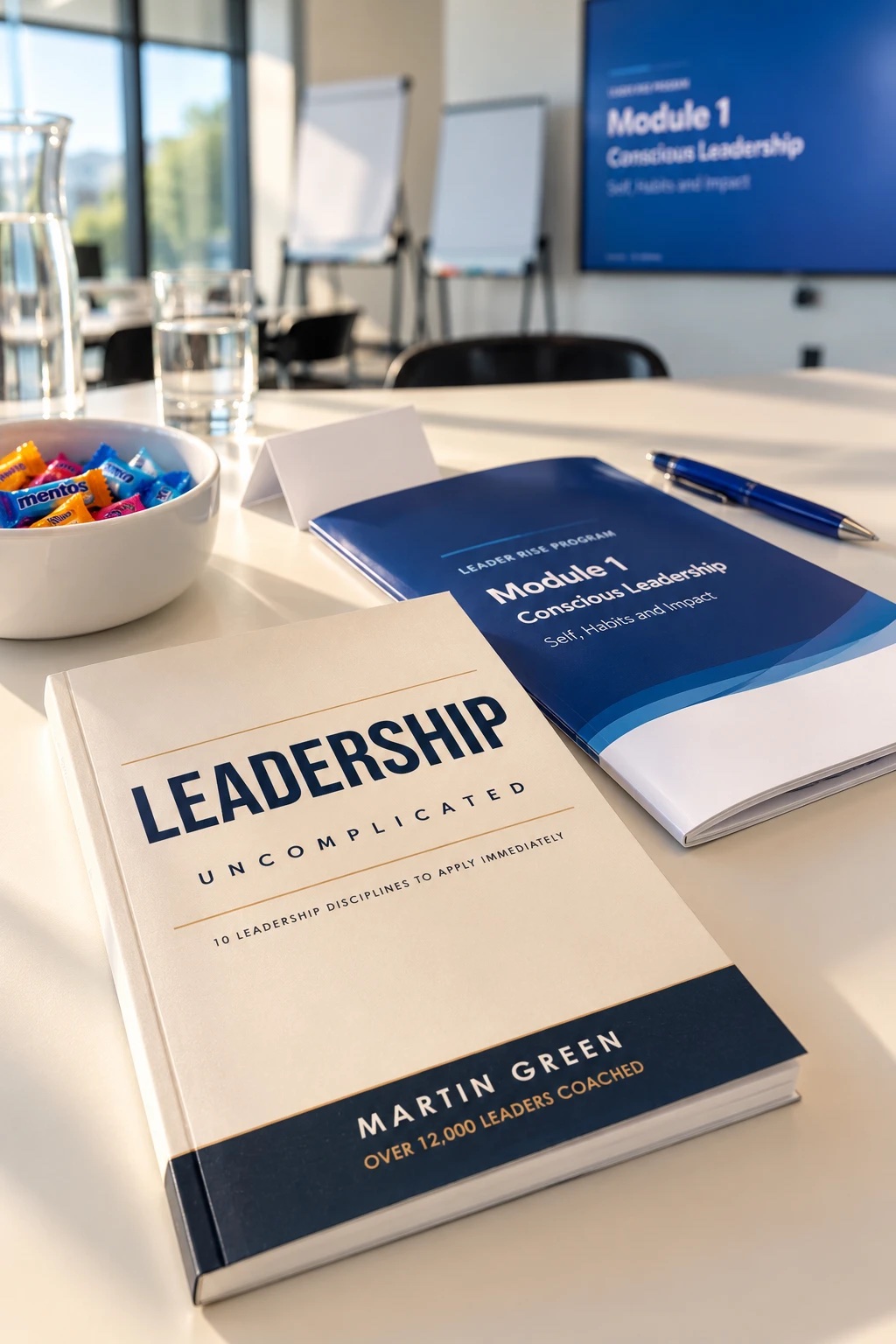
10 leadership disciplines to apply immediately
Leadership Uncomplicated, by Martin Green
This is not another book of theories.
Simple and practical. For leaders who want to lead better, not learn more theory.
Leadership Uncomplicated is a short, practical book for leaders who already know what good leadership looks like and want to do it more consistently. It deals with the everyday moments that make leadership feel harder than it is: the meeting that drifts, the issue left too long, the conversation put off. Each idea comes with something to try at work straight away.
Martin wrote it from his work with leaders in mining, utilities, ports, heavy industry and councils. Over 12,000 leaders coached.
Second edition in preparation. Email us to hear when it is out.
Read the Introduction and the opening of Chapter 1, free.
Introduction
Most leaders are not failing because they lack intelligence or capability. In many cases, they are experienced and thoughtful individuals who care deeply about the organisations and teams they lead. What drains them is not a lack of knowledge but the constant noise that surrounds modern leadership.
Their days are filled with meetings that drift without direction, conversations that circle problems rather than addressing them, and tensions between people that everyone hopes will resolve on their own. Issues that should have been addressed weeks earlier slowly accumulate until they become something larger and more difficult to manage.
If you are in a leadership role, this may sound familiar. In this environment, even capable leaders find themselves pulled into a cycle of reaction. Instead of shaping events, they spend their time responding to them. Instead of preventing problems, they manage their consequences.
Leadership Is Not Complicated: It Requires Discipline
The truth is that most leaders do not need more theory. What they often need instead are fewer distractions, simpler habits, stronger conversations, and meetings that actually lead somewhere.
The problems leaders described were rarely mysterious. In fact, many of the solutions were already known to them. What was missing was clarity about what truly mattered and the consistency to act on it. Over time, I became convinced that most leadership difficulties come down to three things: a lack of clarity, a lack of consistency, and a lack of follow-through.
Leaders often know what needs to be done, but it is not done early enough, clearly enough, or consistently enough. In complex organisations, delay does more than create frustration. It costs time, energy, trust, and eventually results.
If you are ready, we will begin with one of the most expensive leadership habits of all.
Chapter 1: Act Early, Prevent Drama
Small problems rarely become big ones because they were difficult. They become big because no one addressed them when they were still small.
Most leadership problems do not begin as major crises. They begin quietly, often in ways that seem too small to confront at the time:
- A team member arrives 10 minutes late one morning, then again a few days later.
- A supervisor who once followed procedures carefully starts cutting corners to save time.
- Negative comments start slipping into conversations.
- A safety standard is ignored just this once because everyone is busy.
At first, these moments may feel minor and easy to rationalise. Maybe you tell yourself it is not worth making an issue of it, that you do not want to overreact or create tension. This is where avoidance begins, and it is rarely about laziness or poor intent. It is psychological. Beneath the hesitation is fear: fear of how the other person will respond, fear of being disliked, fear of being seen as overly critical or as a bad leader.
In hundreds of conversations with leaders at all levels, this pattern shows up consistently: The discomfort of the moment outweighs the cost of delay, so the conversation gets postponed. But avoidance has a price. Delay does not remove the issue; it compounds it. Standards drift, behaviour normalises, and what was once an exception becomes accepted practice.
The uncomplicated leadership response is simple, but not easy: Address it early. Do not wait for the perfect moment or the perfect words. Especially in environments where feedback is not the norm, it will feel uncomfortable at first. However, think carefully about the real risk, not the imagined reactions, but the consequences you already know come from saying nothing.
Small Shifts Become Big Problems
Small lapses in a team rarely seem serious enough to address immediately. A late arrival, a half-done process, or a task completed carelessly often feels too minor to stop the day and confront. Many leaders notice these moments but decide to deal with them later, or quietly fix the issue themselves to keep things moving.
In the moment, this feels efficient. It avoids awkward conversations and keeps productivity flowing. But over time, it sends a subtle message that problems will be handled quietly and no one needs to change their behaviour.
Meanwhile, others in the team are paying attention. High performers, those who arrive on time, follow standards, and do their work properly, notice the inconsistency. At first, they expect the leader to address it. When nothing happens, they begin to question whether the standards really matter.
Resentment builds quietly. The frustration is not the mistake itself, but the lack of consistency.
This is how many leadership problems begin: not with a major failure, but with small moments that seemed too minor to address at the time, quietly shaping the team’s culture over time.
Want the rest of the book? Get Leadership Uncomplicated →
What readers say
simple approach to leadership is key.
Manager, Evolution Mining, 2024
Read this book, then set a reminder to read it again in 12 months.
Mark Roberts
Program Director, WaterNSW
The book and the program
The book and our leadership development program share a name. The program, Leadership Uncomplicated, is how LeadChange works with frontline and senior leaders over time, and the book is its pre-reading. Participants arrive having read the relevant section for the workshop, so sessions go straight to practice back at work.
Your recommendation is appreciated
Been through a LeadChange program? If a colleague elsewhere is dealing with the same thing, send them this page. Email this page to a colleague
Next step
Want the ideas in the book working in your organisation?
30 minutes. No obligation. We’ll tell you whether we can help.